Not everyone can travel to CERN, the lab in Geneva that houses the Large Hadron Collider (LHC), so how can the study of particle physics be brought into classrooms?
You develop a workshop for teachers that focuses on how to use datasets from the Data Preservation and Open Access (DPOA) working group at CERN, and enlist the aid of two Saints to help facilitate it.
Matt Bellis, Ph.D., professor of physics and astronomy at Siena, is a member of the CMS experiment, one of the four general-purpose detectors at the LHC. He serves as a co-coordinator for its Data Preservation and Open Access (DPOA) working group, which makes research-quality data available to other scientists and the general public through the CERN Open Data Portal.
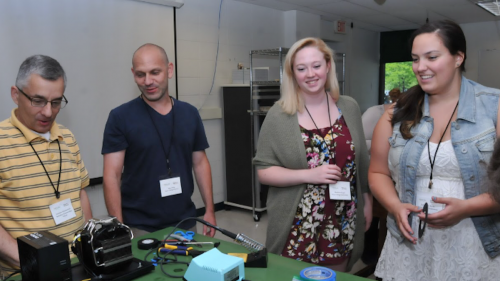
Particle physics studies the very smallest components of matter and how they interact to create the universe in which we live, Bellis explained. Scientists use the LHC to test their ideas about these particles. Teacher workshops bring together high school and college instructors who want to engage their students in this science. To facilitate one using CERN data, Bellis, Emily Rensch ‘29 and Katie Salvatore ‘29 went to the first CMS Open Data Workshop and Pedagogy Hackathon held in July at the University of Notre Dame, home of the National Science Foundation-funded Quarknet outreach program.
About 70 teachers learned about current education efforts, exercises and materials and then had breakout sessions to create their own materials for their classrooms.
“It was a great success!” said Bellis. “The teachers loved the opportunity to spend time to sit with these datasets and talk with other teachers about how to incorporate them into their classroom activities.”
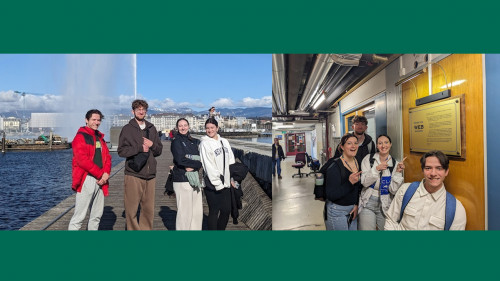
Rensch and Salvatore, who recently traveled to CERN, helped organize and facilitate a workshop where they assisted teachers with the code needed to access the data. They also provided their perspective as students to these same teachers.
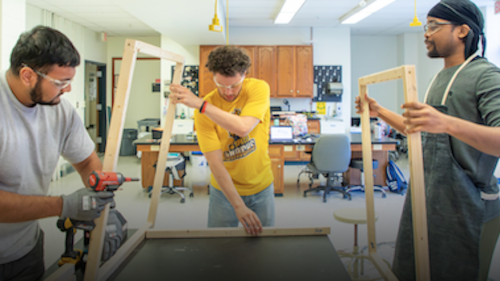
Rensch said what stood out to her specifically on the trip was when they were shown a Quarknet lab where some students were making parts to go on the detector at CERN.
“Before the visit, I had no idea the magnitude of collaboration going on to actually build the detector," she said.
“Even before my trip to Notre Dame, physics education certainly piqued my interest,” said Salvatore. “After working alongside and connecting with fellow physics educators from around the world at such a renowned university, I am more than confident this is a field I want to pursue.”
Bellis explained that these scientific discoveries only have real meaning if they can be shared with the general public.
“This can’t just be for working scientists; it has to be for everyone,” he said. “Anything we can do to bring these ideas and datasets into the classroom for hands-on activities is a good use of our time and energy, particularly at a time where funding for scientific research is being cut and devalued.”
Bellis and the students are now collecting what was learned at the workshop and building a CMS collaboration hub that makes it easier for teachers to find materials for their classrooms.
This work was supported by Bellis’s grant from the NSF and Siena’s Center for Undergraduate Research and Creative Activity (CURCA).