Siena now offers its first academic program to carry the “engineering” designation.
The New York State Board of Regents recently approved the University’s bachelor of science in engineering physics, following review by the New York State Education Department and the State Board of Engineering. The program features tracks in mechanical and electrical engineering.
The new major builds on Siena’s established strengths in physics while preparing students with the technical knowledge, engineering design experience, and analytical skills needed to succeed in today’s workforce, according to Anne McCarthy, Ph.D., dean of the School of Science.
“The curriculum also emphasizes communication, ethical decision-making, and leadership development,” said McCarthy. “Graduates will become engineers who are equipped not only to solve complex technical problems, but also to lead with integrity.”
The addition of the B.S. in engineering physics responds directly to sustained student demand. According to Allison Turcio, Ed.D., dean of enrollment and marketing, “engineering” has consistently been the most frequently searched academic program that Siena did not offer.
McCarthy explained that rather than simply learning how to apply existing solutions, Siena students will learn to understand why systems work.
“That first-principles approach gives graduates the ability to adapt as technologies change and tackle complex problems throughout their careers.”
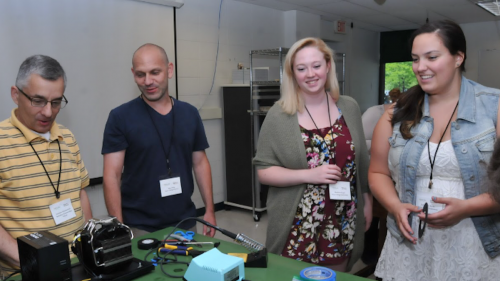
The curriculum combines scientific theory with engineering application. Students will develop skills in engineering design, experimentation, modeling and problem-solving while working with laboratory equipment, engineering software and makerspace resources. The program is designed around ABET accreditation standards, providing rigorous preparation for engineering careers and graduate study.
From their first year, students can apply classroom concepts through research, design projects and other hands-on experiences. Small classes and individualized faculty mentorship provide additional opportunities for students to develop their skills and build relationships with professors who understand their goals.
Students will be ready for employment upon earning their B.S. The program’s broad foundation is designed to give students the versatility to pursue multiple engineering career paths while continuing to learn as technology and industries evolve. A combination of physics, mathematics and engineering application prepares students for opportunities in industry, research and advanced study, including planned 4+1 graduate pathways.
“Graduates will be prepared to solve problems that don’t neatly fit into one engineering discipline,” said McCarthy. “They’ll be able to keep more career options open without committing to one specialty too early.”