Practicing gratitude has become a popular buzzphrase these days, but there is far more nuance to the concept than we might think.
Tony Manela, Ph.D., department chair and associate professor of philosophy, focuses on gratitude in normative ethics in his academic work. (It was also the topic of his doctoral dissertation.) His research was featured prominently in a November 26 article in The New Yorker entitled “Why Is Gratitude So Difficult?”, an important topic any time of year but especially relevant the week of Thanksgiving and heading into the December holidays.
“Gratitude has many different faces,” said Manela, “It can be viewed from many different perspectives, including as a debt or obligation, as a virtue or as an emotion. It’s also a great source of philosophical puzzles.”
The New Yorker article quotes Manela’s exploration of whether it’s possible to be grateful to someone for doing something without necessarily being grateful that they did this thing.
“Gratitude isn’t obviously a concept capable of generating such perplexities,” Rothman’s article reads. “But it has its hidden depths. Manela is among the philosophers who believe that the single word ‘gratitude’ actually refers to two ideas, which may or may not be related.”
One of those ideas is “prepositional” gratitude – gratitude to someone for something. For example, a friend watches your dog while you’re on a trip, or more seriously, a lifeguard saves you from drowning. The other is “propositional” gratitude – a more general gratitude that things are the way they are.
“Gratitude has only recently started getting serious attention from philosophers. For a long time, it wasn’t thought to be as significant or complex as promise keeping or contrition, because unlike those things, gratitude can’t be demanded, and therefore was not seen as particularly weighty,” he said.
But gratitude can indeed be significant and weighty.
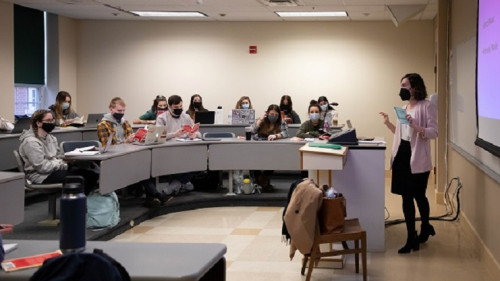
Manela teaches courses at Siena in critical thinking, Philosophy and Law, and Environmental Ethics. In the class on the environment, students explore if humankind should be grateful to nature, or grateful that nature exists.
“As far as prepositional gratitude goes, we only owe gratitude to people or things that benevolently try to help us,” he explained. “Nature is indifferent to us, therefore we do not owe it gratitude, but we can grateful that it exists for many reasons.”
In the law class students explore what if any gratitude is owed to the state and why, and how that can manifest itself through obeying laws or paying taxes.
Manela is the author of the entry on gratitude in the Stanford Encyclopedia of Philosophy, and he is currently writing a chapter on the subject for the forthcoming Oxford Handbook on Political Obligation, due out in 2025.
Cadyann Douglas ‘24 is currently pursuing her doctorate in philosophy at Washington University of St. Louis and was inspired by her former professor’s research and teaching.
“Dr. Manela’s impact on my philosophy studies resonated with me long after my class with him ended,” said Douglas. “I frequently call on his work on gratitude now as a Ph.D. student, namely in a seminar on Knowing, Trusting, and Intending. His analysis of gratitude, and when it is fitting to have gratitude, has helped me make insights on the nature of trust I otherwise would have missed. Not only is his research impactful, but his teaching shaped me into a stronger writer, a more prepared professional, and a better philosopher all around!”
Melanie Osborn-Smith ’25 noted Manela’s academic strength and encouragement of his students.
“As a professor, it is evident that he wants his students to perform at their best while also understanding the content of the class,” she said. “Some of my best work has resulted from his classes and the guidance he provided in the discipline of philosophy.”