When two of Siena’s friars take part in the United Nations’ COP30 climate symposium this month, they will be bringing with them a special gift from Saints studying environmental ethics.
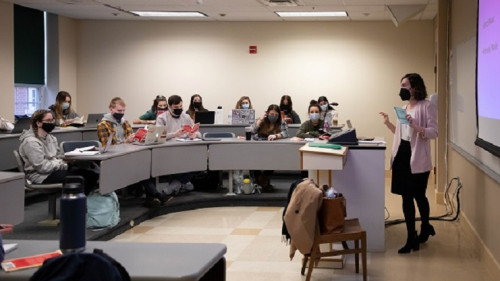
Students in the class taught by Nora Mills Boyd, Ph.D., professor of philosophy, added their artistic touches to a Parachute for the Planet, a (non-functional) play ‘chute that is part of a global movement to address the climate emergency. These symbols of commitment are decorated by students and activists around the world with artwork and pledges to sustainable actions and the United Nations’ Sustainable Development Goals. This community-strengthening experience brings people together to take meaningful action and advocate for stronger environmental laws.
“We know that the future of a livable planet is at stake and that we need to act intelligently, ethically, and swiftly,” said Boyd. “We also know, as Pope Francis’ encyclical on climate change argued, that what is required is nothing short of a fundamental cultural shift to a new and universal solidarity. We hope that public participation in the events surrounding COP30 demonstrate that many U.S. citizens are working hard to address the climate crisis in our own lives, in our institutions, and in our communities.”
The Saints’ parachute will be brought by Laudato Sí’s Br. Michael Perry, O.F.M. and Br. Jacek Orzechowski, O.F.M., to COP30, being held November 6-21 in Belém, Brazil. The friars will attend sessions with government leaders, scientists, and non-profits to examine action plans and paths forward.
Chase Martino ’26 said the parachute project is a way to show the world that what humans are doing to the climate could ultimately destroy our wildlife and landscapes. The class incorporated both upstate New York imagery and Siena’s Franciscan values in their artwork.
“Our goal is to communicate hope for all, and by viewing the parachute you can see we are able to rebound from our mistakes and enjoy the beautiful nature given to us,” said Martino. “We want future generations to be able to enjoy wildlife as we have it today.”