A state environmental administrator shared with Saints the traditional Thanksgiving Address embraced by the Iroquois confederacy, and the words uncannily echoed St. Francis’ call to celebrate and protect the Earth.
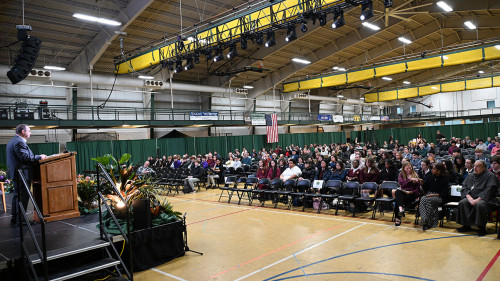
Peter Reuben, director of Indian Nation Affairs for the New York State Department of Environmental Conservation, spoke on “Care for Mother Earth: Linking Indigenous Wisdom with Effective Action” November 18 in the SSU. He said the address is not related to the American autumn holiday, but is rather invoked throughout all seasons and at all types of gatherings to praise the Creator for the gifts of land, water, sun, wind and all life forms.
“This is not about turkey. It is a prayer that puts us in the right mindset, allows us to center ourselves, and reminds us of our connection to the Earth,” Reuben said. “The environment is very difficult to separate from Indigenous peoples.”
Reuben, a Native American who was trained as a chemist, was hired by NYSDEC to address education and remediation on contaminants, and to work with Indian nations to remove them in non-destructive ways from Native lands and protect those lands going forward. He jokingly noted that he told his employer when he was hired that “my relatives have ten thousand years’ experience working on environmental issues.”
In his work with NYSDEC and in his community outreach, Reuben encourages people to think about what impact industry and human activity have on the environment and culture. He believes that Native knowledge and traditions are starting to be seriously considered by government and non-profits in their operations.
Ronaldo Velazquez HEOP ’29 found Reuben’s presentation “resourceful and insightful,” noting especially Reuben’s concern that tribes distrust the state government but not the federal government, and that consultations at the state level were the biggest leap forward to communicating with the tribes.
“This remark stood out for me because it stresses the need for respect and authority by proposing a formal, nation-to-nation relationship,” said Velazquez. “The goal is to establish direct communication to resolve shared concerns and hold the government accountable, preventing neglect or oversight. It taught me that for effective resolution of environmental issues, a direct line of communication is essential to secure commitment and accountability from all parties involved in protecting our shared Earth.”
Maya Wintermantel ’29 said she enjoyed learning how New York state “is actively working with the nations for better solutions that benefit everyone.
“It directly related to discussions we have had in class about the importance of cooperation and making caring, focused efforts to positively impact our changing climate,” she said.
Br. Jimmy Kernan, O.F.M., assistant director of Siena’s Laudato Sí Center for Integral Ecology, introduced Reuben by quoting from Pope Francis’s Laudato Sí encyclical: “It is essential to show special care for indigenous communities and their cultural traditions. For them, land is not a commodity but rather a gift from God and from their ancestors who rest there, a sacred space with which they need to interact if they are to maintain their identity and values. When they remain on their land, they themselves care for it best.”