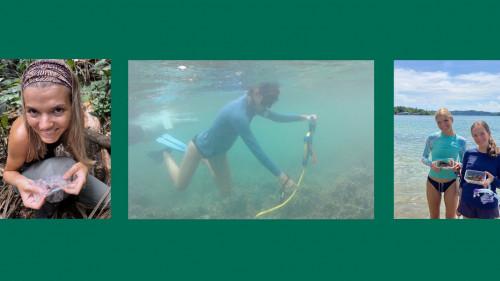
Isabelle Rowley '26 is a WWOOFer. It's one way she's helping to save the planet, while also seeing much more of it. Even if you'd rather not WWOOF, there's an opportunity next month for all Saints to join Rowley's cause.
Rowley spent much of her summer in Denmark. She worked five hours a day, from 9:00 to 2:00 with a built-in lunch break, and was otherwise free to tour the countryside and beyond. Oh, and lodging and meals were covered. All Rowley had to do was pay for a flight... and feed about 3,000 chickens each day.
"Two summers ago, I was with a group of volunteers in Hawaii. We were working on a farm and I met other volunteers from a different program. They told me they were WWOOFers. I had never heard of it, but I thought, 'I've got to look into this.'"
Worldwide Opportunities on Organic Farms (WWOOF) is a global movement connecting organic farmers with ecologically conscious volunteers who have a bug for world travel. WWOOFers help out on an organically certified farm – assisting with the harvest, completing chores, learning about sustainability – and in exchange, receive free room and board during their stay. A few farms and volunteers founded WWOOFing in the 1970s and today hundreds of thousands of volunteers participate each year at organic farms spread throughout more than 130 countries.
"I would help with weeding, beekeeping, even jam making. Sometimes I'd feed the chickens (below, left). I had an amazing time. These farms are inspiring the next generation to get involved in agriculture. A lot of people look down on farmers. I don't get it. We depend on farmers for every single meal."
Organic farms grow and process crops and food without the use of synthetic fertilizers or pesticides. They take care to protect the natural ecosystem as opposed to some processes that undermine it. For Rowley, an environmental studies major, that's the draw.
"My dad has always been into hiking, so when I was younger, my parents wanted to me to go to a camp that emphasized nature at its root. New York's Department of Environmental Conservation offers a camp that puts an emphasis on environmental education. It was perfect. That same camp also helps a lot inner-city kids gain access to nature. That's really were my passion for ecology started."
Rowley grew up less than five minutes from campus – "Siena is closer to my house than my high school" – but she tried a different college for one year because she wanted to get away. Rowley quickly realized she belonged at Siena, and it only took a handful of classes to figure out her purpose.
"I had a professor say, 'Look around you. Do you see anything gross?' In more affluent neighborhoods, like Loudonville, they don't build coal plants. If I go five minutes in one direction from where I grew up, there's a food desert in Albany, but five minutes in the other direction, and I'm in Loudonville. There's an injustice when it comes to ecology and access to healthy foods. I want to help fix that."
For starters, Rowley will serve on a panel next month as part of Siena's two-day conference, "Earth's Cry, Humanity's Call: A Symposium on Integral Ecology." She'll speak about environmentally conscious initiatives already under management at Siena, and she hopes to inspire her fellow Saints, and all participants, to consider ways they can individually make a difference.
"I think a lot of college students see environmental issues in the media and believe that it's political and they have to pick sides. But really, you can simply start by planting a tree in your backyard. People lack environmental education. We don't talk about it. This symposium is going to change that."
Want to make a difference? Register today for the October 10-11 symposium!