WHAT IS THE FRANCISCAN LINK TO EDUCATION?
Franciscans have been involved in education for hundreds of years. A few years after the founding of the Order of Friars Minor, the friars began teaching at the University of Paris (1219), at Oxford University (1224), and at Cambridge University (1230). They quickly became popular teachers of the arts, sciences, and theology because of their knowledgeable scholarship and their practical and matter-of-fact style of teaching.
This popularity was often the source of conflict with non-Franciscan faculty members who saw the friars taking away their students! There were even statutes in many universities that stated Deans of Theology could only be appointed from among the Franciscans. The popularity of Franciscans as educators spread throughout Europe and by the end of the 13th century there were Franciscans teaching in Germany, Spain, and Italy as well. The attraction of Franciscan education lay in its attempts to deal with the most challenging and existential questions of human existence in a grounded and practical way.
For Franciscans, education is not pursued for knowledge's sake alone or to gain a profitable career alone. Knowledge for Franciscans is a gateway to understanding God and God's will in human life and destiny. The "more" that Franciscan education offers is the "more" of faith, where faith is a means to understanding who we are and for what reason we have been created. When you leave a Franciscan college or university, like Siena University, you will not just be ready for a job with good pay; rather you will leave with a perspective on life that is filled with a sense of hope of what can be possible in our world.
WHAT IS THE DIFFERENCE BETWEEN A PRIEST AND A BROTHER?
St. Francis always tried to walk in the footsteps of Jesus by “living the Gospel.” He referred to his initial followers as “brothers” since he wanted them to be “brothers” to one another and to people. These followers were laymen and some were ordained priests. Over time, the laymen were addressed by the title of “Brother” and the priests by the title of “Father.” The distinction in titles is expressed in the type of ministry that each one does – a “Lay Brother” is called to do the ministry of the baptized – to preach, to teach, and to reach out in service to people in need. The “Father – the Friar-Priest” exercises the ministry of the baptized and is also called to celebrate the sacraments of the Church.
Today, greater emphasis is being place on the title of “Brother” for all Franciscans. In addressing any Franciscan Friar, a person is never wrong by calling them “Brother” or “Friar.” We rejoice in our identity to be “brothers” to one another and to all people.
HOW MANY FRIARS LIVE AT SIENA?
There are currently 18 friars in residence at the Friary.
The Friary is the place where the friars live and is named for St. Bernardine of Siena, the patron saint of Siena University. It is located across from the Foy Center upper parking lot, adjacent to Siena Hall. Fr. Kevin Mullen is the Guardian of the Friary. He works with Br. Brian Belanger, Fr. Ken Himes, and Fr. Dennis Tamburello, who are the Vicars (assistants to the Guardian).
WHAT IS THE GUARDIAN'S JOB?
The title Guardian is given to the person who is head of the Friary. Fr. Kevin Mullen is the current Guardian of St. Bernardine of Siena Friary at Siena University. His job is to look after the friars. He is the one the friars turn to whenever they need something, when they need an ear to listen, or when one has an idea for the community. He sets the tone for the house and, with the help of the Vicars of the Friary, decides on policies and the vision for a particular year. In addition the Guardian is in charge of the upkeep and administration of the Friary, and he acts as the principal liaison between the Franciscan Community and the University.
WHAT DOES IT MEAN TO LIVE AS A FRIAR?
To live as a friar means to live in a community of men bound by a common mission. This mission is to carry out the message of Jesus Christ as St. Francis of Assisi understood it. Friars do this through something called the Vows. These vows are public commitments that each Friar must personally make stating that he will live without property of his own (Poverty), will live a celibate life in community (Chastity), and will sacrifice his needs for the needs of others (Obedience).
Friars share what resources they have or gain so that the whole community may be enriched and that they might enrich the lives of others. The vows are not intended to be burdens, but are embraced as a means of opening one's life to the goodness of God and God's grace in one's life.
Francis always speaks of accepting the vows with joy. If they cannot be embraced as such, then they are not vows but chains. It is hope that the witness of a friar's life will free others from the imprisoning and often times demeaning tendencies of materialism and contemporary culture. In all things, a friar hopes to be a witness to all people of the power of God's love and presence in human life and history.
HOW IS THE FRANCISCAN TRADITION EXPRESSED IN THE NAMING OF BUILDINGS AND PLACES ON THE SIENA CAMPUS?
Many of the buildings on this campus are named for Franciscans:
The Ben Kuhn House (near Gioia Hall) is named for the affable and gregarious Fr. Benjamin Kuhn, OFM, one of the seven founding Friars of Siena University, who taught everything from History to Chemistry. He served the Siena community for over 50 years.
Clare Center, the home of the Department of Religious Studies, is of course named for St. Clare of Assisi.
The Friary and Siena Hall are named for St. Bernardine of Siena, a fifteenth century Franciscan preacher who was known as a "second Apostle Paul" for his proclamation to all of Italy of the Holy Name of Jesus. He is the patron saint of Siena University, and before 1968, Siena's official name was St. Bernardine of Siena College.
All of the residence halls, excepting the townhouses, are named for friars.
Hennepin Hall is named for Fr. Louis Hennepin, a French Franciscan who accompanied LaSalle in his explorations of North America in the 17th century. Fr. Hennepin explored Western New York State and was the first European to see Niagara Falls.
Padua Hall is named for St. Anthony of Padua, the first Franciscan theologian, who was a contemporary of St. Francis.
Plassmann Hall, the first residence hall built on campus (1958), is named for Fr. Thomas Plassmann, a founder of a Siena University, a former Provincial of Holy Name Province, and a president of St. Bonaventure University. It was while Fr. Plassmann was President of St. Bonaventure University that he worked with Bishop Gibbons of Albany to establish Siena (College) University in his diocese. Fr. Plassmann also gave the address that dedicated Siena Hall in 1938.
Ryan Hall is named for Fr. Benvenute Ryan, another Provincial of Holy Name Province from 1925 to 1931.
Hines Hall is unique in that it is named for a living friar, Fr. Hugh Hines, seventh president of Siena University from 1976 to 1989.
The house at 33 Fiddler's Lane, Serra Manor, is named for Fr. Junipero Serra, O.F.M. Fr. Serra was a missionary in the Californias during the 18th century establishing 21 missions along the Pacific coast of United States.
Roger Bacon Hall is named for the great Franciscan scientist of the fourteenth century who is credited with discovering the principle of the telescope and the microscope, and for having invented gunpowder -- but because of its destructive capabilities hid the formula in an anagram which was only recently solved in this century. He was a maverick when it came to studies and never fit happily into the academic routine which most of his fellow scholars adopted so readily.
St. Francis House, where the Office of Development and Alumni Engagement resides is named for Francis of Assisi.
Franciscan Friars Commons is a gathering/event space in the Patricia Gioia Hall Welcome Center. It was formally opened on September 22, 2022, the day of Siena's 85th birthday celebration.
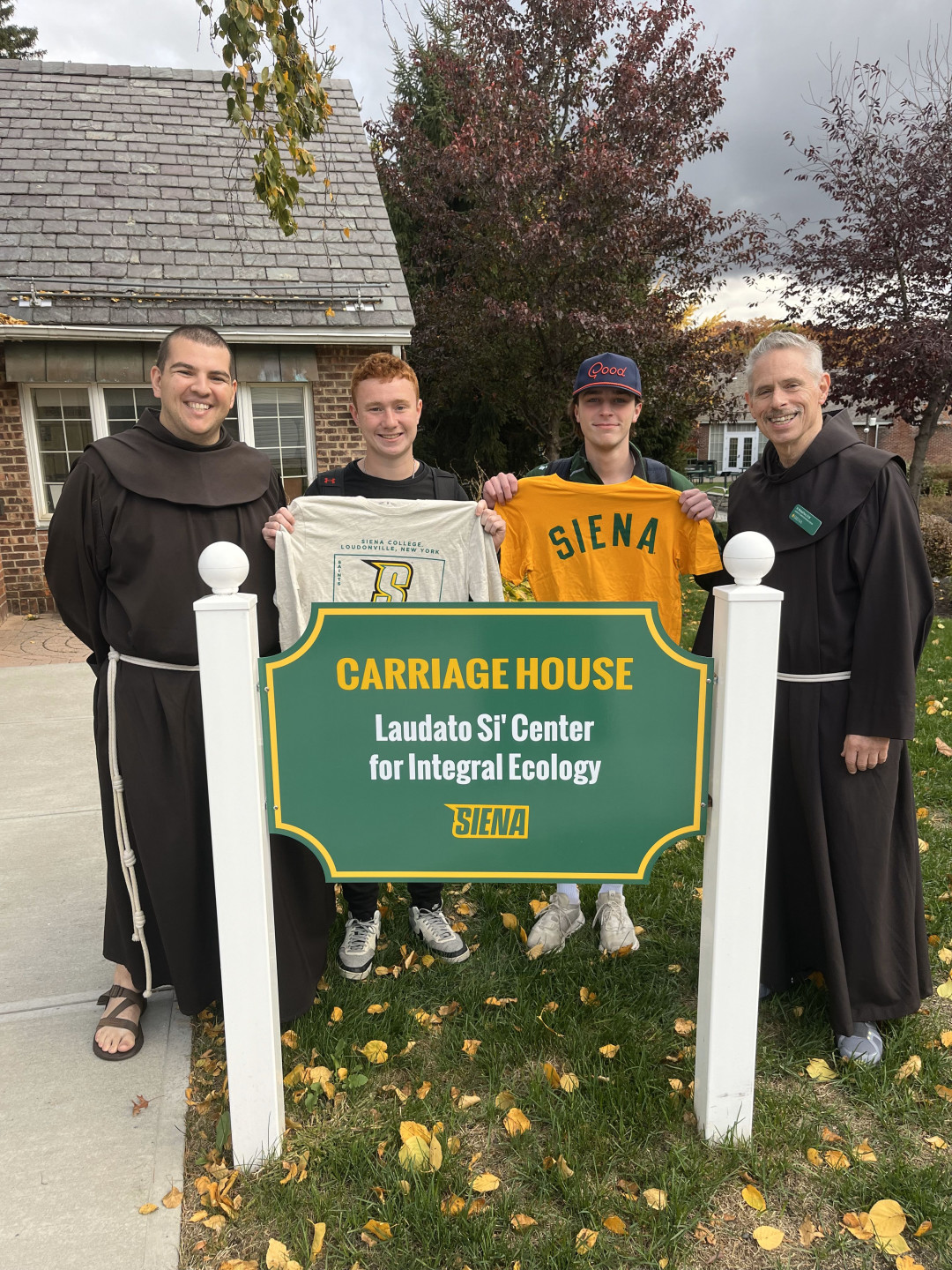
The Laudato Si' Center for Integral Ecology is located in the Carriage House, next to Gioia Hall. Inspired by the vision of St. Francis of Assisi in the Canticle of the Creatures and Pope Francis' 2015 encyclical letter, from this place friars and students advance their mission. We share with you Siena's efforts for sustainability and how you can get involved.
The Stations of the Cross are a devotion deeply rooted in Franciscan tradition. The Stations date back to the friars being given custodial responsibility for holy places in the Holy Land, particularly those that are associated with Christ, by the Pope in the 14th century. Siena has a dedicated outdoor space featuring a series of 14 representations of Jesus's final journey to his crucifixion and burial. A stone bench at each station provides a place to pause and reflect.
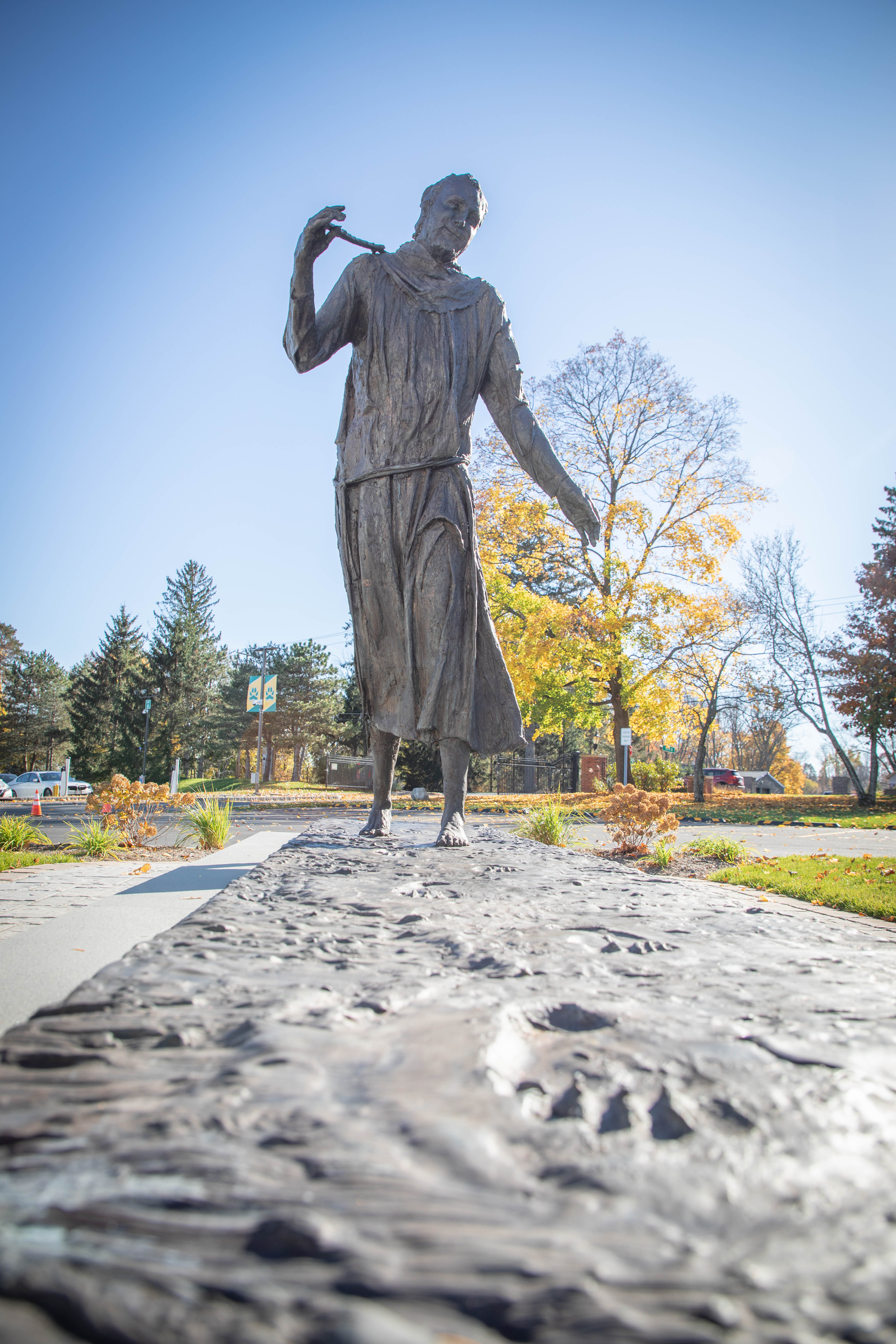
A Statue of St. Francis of Assisi designed by John Collier, renowned internationally for his inspirational work, was installed in 2022 on the main path to the front door of Patricia Gioia Hall, leading the way towards the building. It depicts St. Francis as a mendicant (a traveler on the road), his arm outstretched, walking in the footsteps of Christ, leaving footprints for those coming after. It was designed to welcome all who arrive on campus to the Franciscan experience and to invite them to join him on this journey.
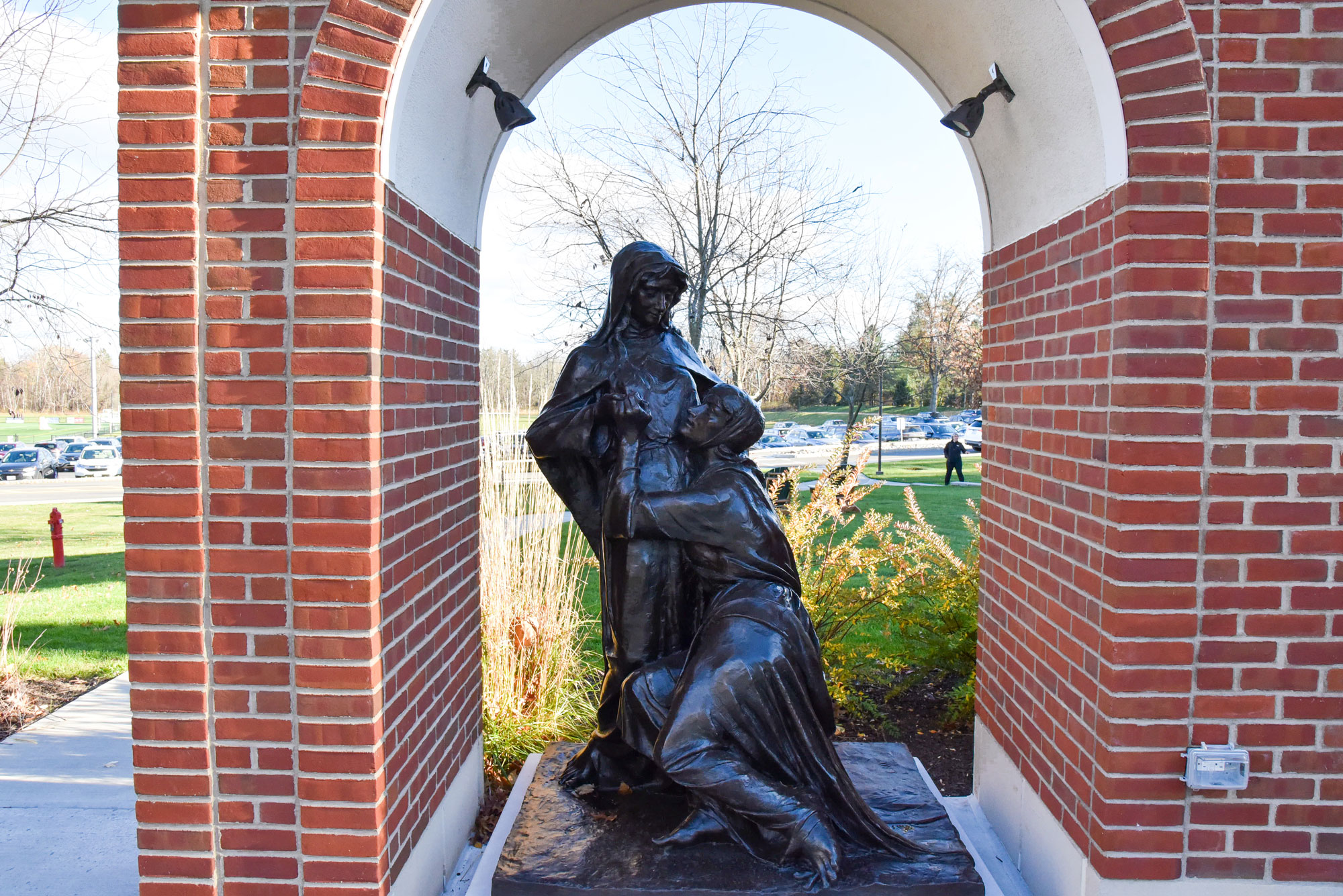
In 2024 a Statue of St. Clare of Assisi was installed in an archway next to the Bells of Remembrance. The statue, designed by Hudson Valley-based artist Chris Alles, is a partner to the statue of St. Francis of Assisi that stands in front of Gioia Hall. The statue reflects St. Clare's life as a healer, caring for a sick sister and holding her in a loving embrace. It was placed in the protected archway to show that she chose to live her life and perform her ministry from a cloistered convent. The statue faces the grotto, as the grotto is a place of prayer. St. Clare dedicated her life to prayer and service.
There is a dedicated plaque in the lobby of each of these buildings commemorating the Franciscan for whom the building was named.