A Beacon of Resilience, Solidarity, and Hope in the Holy Land and Beyond
“Peace, justice and the preservation of creation are three absolutely interconnected themes, which cannot be separated and treated individually without once again falling into reductionism”. Everything is related, and we human beings are united as brothers and sisters on a wonderful pilgrimage, woven together by the love God has for each of his creatures and which also unites us in fond affection with brother sun, sister moon, brother river and mother earth.
– Pope Francis, in the encyclical Laudato Si’ # 92
The Tent of Nations and its Story of Nonviolence, Resilience, and Hope.
Tent of Nations is a peace project established in 2001 by the Palestinian Christian family of Daoud Nassar on a portion of the family farm. Its 100 acres of land are located about six miles southwest of Bethlehem in the West Bank. The land, purchased by their family in 1916, has been cultivated for over 100 years, passing down responsibility from one generation to the next. The farm with its Tent of Nations is surrounded from nearly all sides by the illegal settlements.
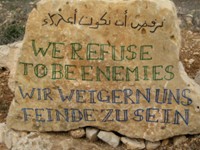
For the Nassar family, their land is sacred and not for sale. For over two decades, the family of Daoud (Arabic for David) has been involved in a non-violent struggle to hold on to the land and resist the efforts to dispossess them. At the entrance to the farm, there is a large stone on which it is written in English, Hebrew, Arabic, and German – We Refuse to Be Enemies. Many people of good will and lovers of justice from around the world – including some Jewish people – have joined the Nassar’s family in their struggle for dignity and justice. Thousands of people have come to visit the Tent of Nations, help cultivate the land, provide some financial means for legal defense, help organize peace camps for local children.
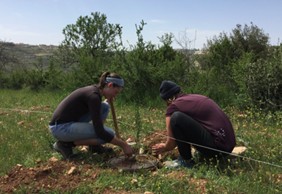
Cultivating the land at Tent of Nations has been made extremely difficult. The Nassar family is denied access to water or electricity. They are also not allowed to build any above-ground structures. And yet, the farm where grape, apple, olive, almond and fig trees grow is being cultivated.
A few years ago, when Tent of Nations faced an imminent threat of demolition, the Franciscans of Holy Name legacy Province were among the key organizations that forcefully intervened. Its timely and decisive advocacy with high-ranking government officials appeared to forestall the likely harm to Tent of Nations. Franciscans of the Custody of the Holy Land have produced a video profile of the Nassar family and Tent of Nations project:
Amidst the volatile political situation, a Palestinian, Christian Arab family of Daoud Nassar and their Tent of Nations project have become a sign of hope for many people in the West Bank and across the globe.
Daoud Nassar was one of the 70 activists, peacemakers, and religious and community leaders from 36 countries invited by the Carter Center for the annual Human Rights Defenders Forum in 2018. At the event, whose themes was Restoring Faith in Freedom, Daoud spoke about four principles that inform his family’s actions of active non-violence (1) Refuse to be victims. (2) Refuse to hate. (3) Embrace nonviolent resistance is a way of life informed by faith (4) Believe in justice.
In New York Time op-ed from July 2025, Nicholas Kristof writes about the Nassars and Tent of Nations, calling them “pioneers for peace that can preserve space for dialogue and better policies.” “American and European governments should do everything possible to keep these embers glowing,” Kristof argues and they “should not allow this “beacon of understanding to be extinguished.”
A reflection on Tent of Nations in the context of the Bible and Laudato Si’
The Judeo-Christian tradition speaks of God’s desire for abundant life that extends to earth and all its creatures. The ancient Hebrew prophets repeatedly summon the people to live out God’s vision of people – shalom – one that included peace with God, peace with the land, peace with all people and earth’s creatures. The prophet Isaiah, for example, conjures up a vision of God’s holy mountain where old enemies are reconciled. The wolf will live with the lamb, he wrote, and the infant will play near the hole of the cobra. (Isaiah 11:6-9)

Similarly, the prophet Micah describes a vision of “the mountain of the Lord” where God “will settle disputes among nations and where they would beat their swords into plowshares and their spears into pruning hooks.” The prophet points to a future where “every person will be able to sit under one’s own vine and fig tree and no one will make him or her afraid”. (Micah 4:2-4)
This ancient vision of restorative justice for both human and non-human creation is poignantly expressed in the life and mission of Jesus. Named the Prince of Peace, born in Bethlehem, Jesus came to preach the good news to the poor and liberty to captives, and proclaim the Jubilee Year. The latter refers to the call to a radical renewal. Our Jewish ancestors in faith, in response to God’s gift of freedom from slavery, were to cancel the debts, restore liberty to the fellow impoverished Israelites, let the land lay fallow so that it could rest and recover its capacity to nourish. The Jubilee Year was a time for a restoration of justice, peacemaking and healing with fellow human beings, with the land and, ultimately, with God.
The Gospel of Luke (4:18-21) tells us that healing the broken bonds of relationship with God, with fellow human beings and creatures beyond, constituted the core message and mission of Jesus. All those who are baptized are called to continue that mission in our world today. The Tent of Nations serves as a compelling and inspirational sign of God’s Kingdom among us through its witness of solidary and defiant hope.
As Christians, we are also called “to accept the world as a sacrament of communion, as a way of sharing with God and our neighbors on a global scale. It is our humble conviction that the divine and the human meet in the slightest detail in the seamless garment of God’s creation, in the last speck of dust of our planet”. (Pope Francis in Laudato Si’ # 9)

Tent of Nations also echoes Jesus’ Sermon on the Mount: “Blessed are the peacemakers, for they will be called the children of God. Blessed are those who are persecuted for the sake of righteousness, for theirs is the Kingdom of Heaven.” Daoud Nassar and his family, along with the international community of people of good will who support the family farm project, incarnate in a beautiful, holistic and tangible way God’s call to shalom.
“The entire material universe speaks of God’s love, his boundless affection for us. Soil, water, mountains: everything is, as it were, a caress of God.” (Pope Francis in Laudato Si’ #84)
The Book of Revelation invokes a vision of a City of God coming down onto a mountaintop. The river of the water of life flows from it. The tree of life planted on each side of the river, yields fruit that will nourish the people; the leaves of the tree serve for the healing of the nations.

For many Palestinian children – Muslim and Christian – living under the Israeli military occupation, often in a situation of great systemic violence, the summer camps at Tent of Nations have been a source of a collective healing. The children also learn to tune in to the voice of God speaking to them in the various forms of beauty found at Tent of Nations. There, the Gospel of Creation speaks to the Palestinian children suffering under the military occupation and constant violence.
In his encyclical Laudato Si’ Pope Francis addresses the world at the crossroads. He says that we can either continue on the path leading to a collapse of life-support system of our planet; or we can pave a way toward a more just, peaceful sustainable future. Pope Francis refers to that transformative path as a Revolution of Tenderness. We need examples that could inspire our world today to reject apathy, cynicism, and despair and opt for a life of deep solidarity and abiding hope.
The Sustainability Efforts at the Tent of Nations
Energy:
The solar power system donated by a German organization meets the electricity needs of the Nassar family and of the volunteers.

Water:
Each year 23 underground cisterns collect rain water, making the farm self-sufficient in water.
Waste water treatment unit:
The sewage water from at the farm is recycled for irrigation.
Composting and Biogas Fuel:
Compost toilets are saving a lot of water on the farm. The biogas fuel unit is already in place. It could be used as cooking gas.
Those kinds of projects will help Tent of Nations to become independent. This is important, especially in case Tent of Nations becomes even more isolated and cut off from the city of Bethlehem.
Educational Garden:
The international volunteers have helped to create an educational garden for the local children. They are able to learn about the different plants, herbs and trees.
How to help?
- Visit and learn more about Tent of Nations
- Pray for a success of Tent of Nations as well as for peace, justice, and reconciliation in the Holy Land.
- Join in the circle of protection around the Tent of Nations non-violence peace project. Protect it against those who seek to push the Nassar family from the land, demolish all the structures, or inflict harm on the land and all who dwell on it.
- Tent of Nations Hope Book Project
- Donate to Tent of Nations:
• Supporting next year’s summer camp for children and youth
• Strengthening the sustainability infrastructure on the farm
• Purchasing and providing care for new trees on the farm
• Providing General support for Tent of Nations to use where most needed.
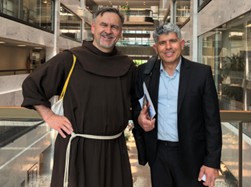
You can watch a short video message from Daoud Nassar recorded in April 2023 during his visit in Washington DC where he participated in the Churches for Middle East Peace Advocacy efforts and met with a number of friars and Franciscan-hearted people.
This reflection was written by Jacek Orzechowski, OFM